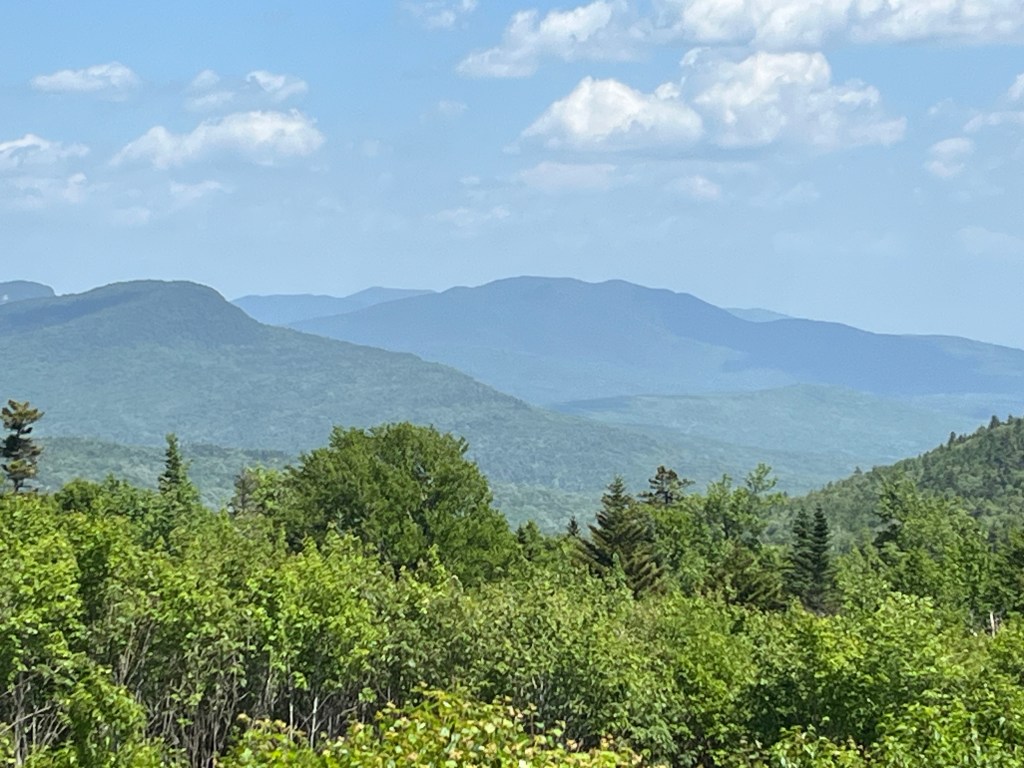
I drove the Molly Stark Scenic Trail from the state park campground towards Brattleboro, Vermont, stopping along the way at some scenic views, including the Hogback Mountain Overlook. From there, I headed north to Woodstock, a quaint town with many Revolutionary War historical markers. I drove just north of Woodstock to the Billings Farm & Museum, a functioning dairy farm, with an 1890 farmhouse and exhibits re-creating 19th-century farm life. I could not bring the dogs anywhere there, and they wanted to charge me $8 to visit the cow barn. I passed.
Adjacent to this place is the Marsh-Billings-Rockefeller National Historical Park, which is the oldest continuously managed scientific forest in the United States. It embodies several generations of conservationist thought and practice, including the contributions of three individuals for whom the park is named. It has many trails, and a man-made lake at the end of a three-mile trail. New England was experiencing a severe heat wave today, so the dogs and I passed on any hikes in the park.
We crossed over the Connecticut River to New Hampshire. Yesterday I took a picture of a small, covered bridge, because I thought that would be the only covered bridge I would see. But the river crossing was through a much larger covered bridge, the Cornish-Windsor Bridge. It was built in 1866 and, until 2008, it was the longest covered bridge (still standing) in the United States. The sign outside the bridge (perhaps not updated after 2008) claims it is the longest wooden bridge in the U.S., and the longest two-span covered bridge in the world. In 1866, Windsor (in Vermont) was “dry” (alcohol free) and Cornish in New Hampshire was wet, so they charged foot travelers 2 cents to walk to Cornish and 3 cents to return. Horse-drawn carriages were charged 20 cents.
In New Hampshire, I first went to the Saint-Gaudens National Historical Park for the Arts, the only national park in the state. It was established to preserve the home and studio of sculptor Augustus Saint-Gaudens. Although I had never heard of him, he was one of the country’s greatest sculptors, having created monuments commemorating heroes of the American Civil War, many of which still stand. He created the Robert Gould Shaw Memorial on Boston Common, the Standing Lincoln statue in Lincoln Park in Chicago, the General John Logan Memorial in Grant Park in Chicago, and the William Tecumseh Sherman Monument in Manhattan. In his later years, Augustus founded the “Cornish Colony”, an artist’s colony in New Hampshire that included notable painters, sculptors, writers, and architects. The park continues this colony, as guest artists still come to work in the park. The park also includes replicas of some of his more famous works, including the Standing Lincoln.
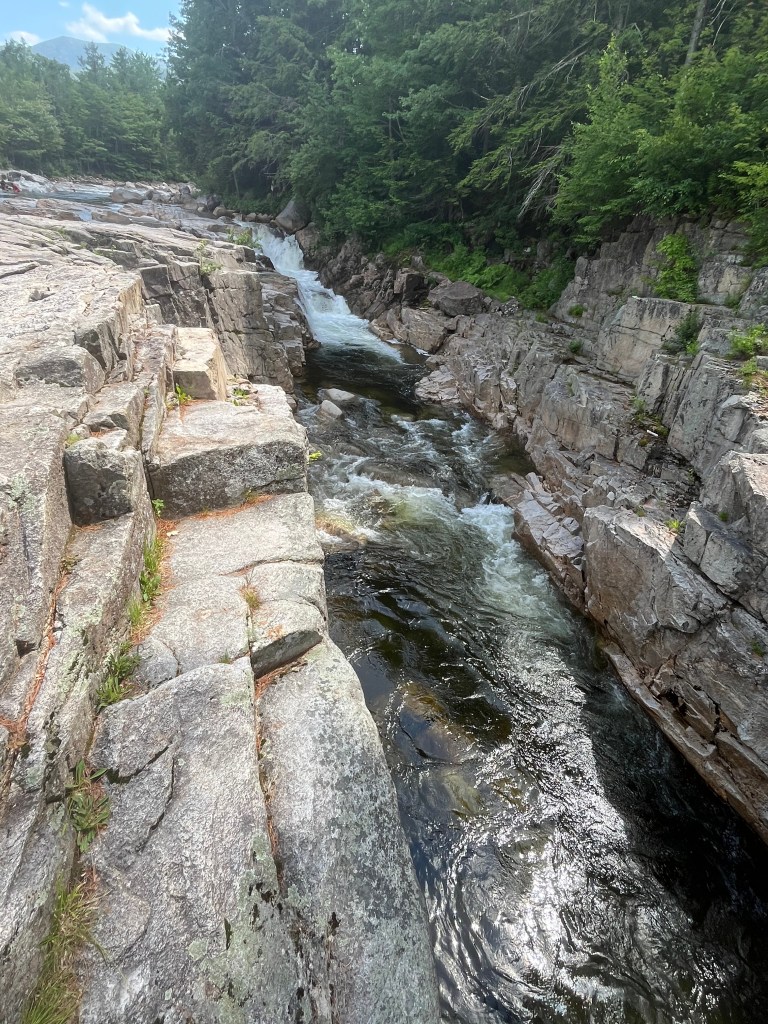
I ventured over to Lincoln, New Hampshire to start the Kancamagus Highway, a 35-mile drive recognized as a National Scenic Byway spanning east to west from Lincoln to Conway, through the White Mountain National Forest. There were many scenic views along the way; I stopped at two. The first was the Sabbaday Falls; I took the dogs for a half-mile hike to the falls. It was still very hot, but the path was in the dense woods of the forest, so it was tolerable. The second stop was at the Rocky Gorge scenic view along the Swift River, still in the National Forest.
As I went through Lincoln, I recalled how many places I have seen in the past eight weeks named after him. I did quick research to see if it is the most frequent location name in the country. It doesn’t even crack the top ten. The winner is Washington, the name for 88 cities, states, towns and counties. Springfield is a distant number two at 41.
From Conway, I drove up north to the Dolly Copp Campground, the largest campground within White Mountain National Forest. With showers, water, and electricity, it is a very comfortable campground at a reasonable price.
Photos include the Hogback Overlook, the covered bridge, the Lincoln statue replica, Sabbaday Falls, and the Rocky Gorge.


 Discover America 2025
Leave a comment